
If your agency can’t clearly explain how their work connects to tour bookings and enrolments, that’s a problem. Reports full of impressions, reach, and engagement without linking them to real business outcomes often hide weak strategy. A strong Childcare Marketing Agency will show you enquiries, cost per enquiry, tour conversions, and how campaigns are adjusted based on that data.
When marketing is done well, you should feel more confident, not more confused. You should know what’s being done, why it’s being done, and what result it’s meant to drive. If that clarity isn’t there, it’s worth asking whether your current partner truly understands how childcare families make decisions.
Table of Contents
-
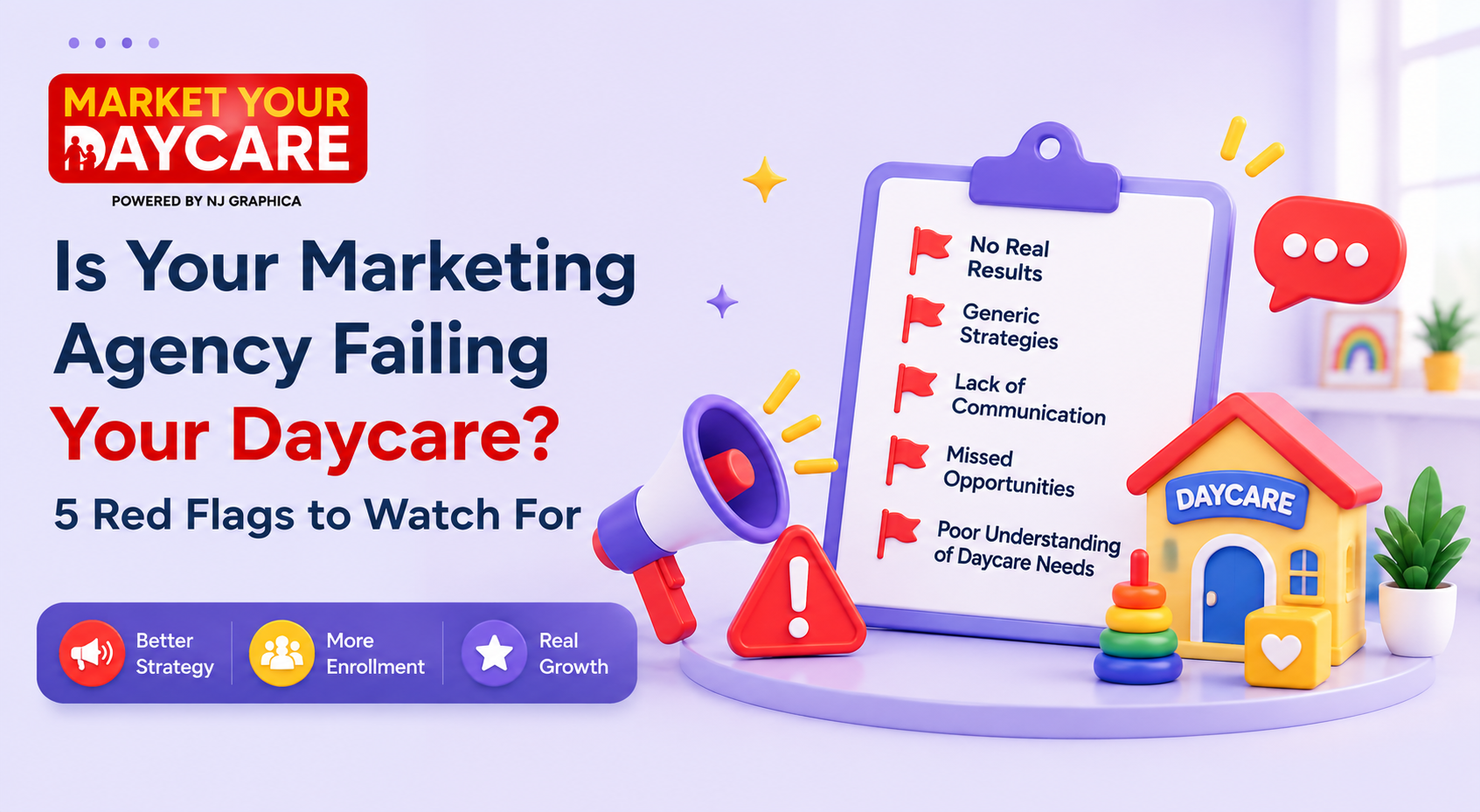
Red flag 1: Vanity metrics instead of enrolment metrics
-
Red flag 2: No clear link between spend and results
-
Red flag 3: Generic strategies that ignore your local market
-
Red flag 4: Poor communication and disappearing accountability
-
Red flag 5: Locked-in contracts with no performance review
-
Why Market Your Daycare matters
-
Conclusion
-
FAQ
Red flag 1: Vanity metrics instead of enrolment metrics
Here’s a common scene. You get a monthly report. It’s colourful. It’s full of graphs. It talks about impressions, reach, post engagement, follower growth, maybe even video views.
But when you ask, “How many tour bookings did this drive?” or “How many enrolments can we trace back to these campaigns?” the answer gets vague.
That’s a red flag.
Vanity metrics aren’t useless. They can show awareness. But for a daycare, the metrics that matter are:
-
Number of enquiries (calls, form fills, messages)
-
Cost per enquiry
-
Number of tours booked
-
Tour-to-enrolment conversion rate
-
Cost per enrolment
-
Occupancy trend over time
If your reports don’t centre these numbers, you’re flying blind. You might feel busy, but you won’t know if you’re actually moving closer to 90–100% occupancy.
A good agency will lead with business outcomes, not just activity. They’ll show you what changed, what it cost, and what it delivered in terms parents and directors can understand.
Red flag 2: No clear link between spend and results
You’re paying for ads, content, SEO, maybe even a website refresh. But can anyone clearly explain which channel is driving which result?
If the answer is “it’s all working together” without any breakdown, that’s a warning sign.
In 2026, tracking isn’t optional. You should be able to see:
-
How much was spent on Google Ads vs. Meta Ads vs. other channels
-
How many enquiries each channel generated
-
Approximate cost per enquiry and per enrolment by channel
-
Which campaigns or creatives performed best
-
What was changed in the last 30–60 days and why
If your agency can’t connect spend to outcomes in simple terms, you’re essentially funding experiments without learning from them.
This doesn’t mean every dollar has to be perfectly attributed. Childcare decisions take time, and parents touch multiple channels before enquiring. But there should be a clear story: “This month, Google Ads drove X enquiries at $Y each. Meta drove Z enquiries at $W each. We shifted budget towards Google because cost per enquiry was lower and tour conversion was higher.”
That’s accountability. Without it, your budget is just disappearing into a black box.
Red flag 3: Generic strategies that ignore your local market
Childcare is hyper-local. Most families aren’t willing to drive more than 15–20 minutes, especially for long-term care. That means your real competition isn’t every centre in the country. It’s the handful within a few kilometres.
If your agency is running the same generic “childcare” campaigns everywhere, without adjusting for:
-
Your suburb and nearby landmarks
-
Local competitors and their pricing
-
Your centre’s unique programs and strengths
-
Your actual capacity by age group
-
Local parent concerns (CCS, transition to school, hours, etc.)
then they’re treating you like a template, not a business.
Generic strategies might generate some clicks, but they won’t generate the right enquiries. You might get more tyre-kickers, more out-of-area calls, or more people who bounce when they hear your fees.
A strong approach is tailored. It speaks to your local catchment, highlights what makes your centre different, and aligns with your actual enrolment priorities.
If your campaigns feel like they could belong to any centre in any city, that’s a sign your agency isn’t digging deep enough.
Red flag 4: Poor communication and disappearing accountability
Think about your last few interactions with your agency.
Who initiates contact? Is it you, chasing them for updates? Or do they proactively share insights, ideas, and performance checks?
Do you always talk to the same person, or does the account handler keep changing without clear handover?
When you ask questions, do you get clear answers in plain English, or a wall of jargon?
These aren’t small things. They’re indicators of how much your business is prioritised.
Common communication red flags include:
-
Senior staff vanish after the sale, leaving juniors with little guidance
-
You have to chase for reports or basic updates
-
Meetings are just retrospectives with no proposed next steps
-
No one can explain which campaign drove your last enrolment
-
Deadlines slip without anyone flagging it or offering a solution
Good agencies don’t disappear between reports. They check in when something important shifts. They propose tests, not just review the past. They make you feel like a partner, not a ticket number.
If you’re constantly feeling like you’re pulling teeth for basic clarity, that’s exhausting. And it’s a sign the relationship isn’t serving you.
Red flag 5: Locked-in contracts with no performance review
Contracts matter. Not because you’re planning to leave, but because they reveal how confident an agency is in its work.
Long lock-ins (12 months or more) with no performance review clauses, no exit options, and no clear KPIs are a structural red flag.
An agency that’s confident in its results doesn’t need to trap you. It’s willing to earn your business month by month.
Watch out for:
-
12-month minimums with no break clause
-
Automatic renewals unless you cancel months in advance
-
No defined KPIs beyond “we’ll do our best”
-
Penalties for early exit that feel punitive
-
Ownership of your ad accounts, pixels, or data, making it hard to leave
These terms shift all the risk onto you. If performance drops, you’re stuck paying anyway. That’s not partnership. That’s leverage.
A fair contract might still have a minimum term (3–6 months is common to allow campaigns to mature), but it should include:
-
Clear KPIs tied to enquiries, tours, or cost per lead
-
Regular performance reviews (monthly or quarterly)
-
An exit clause if agreed KPIs aren’t met
-
Confirmation that you own all assets (ad accounts, pixels, content, data)
If your current agreement feels one-sided, that’s worth a serious conversation.
What good looks like instead
So if those are the red flags, what does green look like?
A strong childcare marketing partner should:
-
Start with your occupancy goals, not just “more traffic”
-
Build campaigns around your local market, not generic audiences
-
Report on enquiries, tours, and cost per enrolment, not just impressions
-
Adjust strategy based on data, not just repeat the same tactics
-
Communicate proactively, with clear next steps and rationale
-
Offer fair contracts that reflect confidence in results
In short, they should make you feel more in control, not less. More informed, not more confused. More confident that your budget is working, not just being spent.
That’s the standard to hold them to.
Why this matters for occupancy
Let’s connect this back to what you actually care about: filling places.
Every month you work with an underperforming agency is a month of lost enquiries, lost tours, and lost enrolments. In a sector where each vacant place can cost thousands per month, that adds up fast.
Good marketing doesn’t just look nice. It moves the needle on:
-
Enquiry volume
-
Enquiry quality (local, serious, aligned with your fees)
-
Tour booking rates
-
Tour-to-enrolment conversion
-
Overall occupancy trend
If your current setup isn’t moving those numbers, it’s not a “trust the process” situation. It’s a “rethink the process” situation.
And that’s okay. You’re allowed to expect better.
Why Market Your Daycare matters
This is where marketyourdaycare fits in.
Market Your Daycare focuses on helping Australian childcare centres reach 90–100% occupancy through results-driven marketing. That means their lens isn’t “how do we make this look good?” It’s “how do we fill these rooms?”
A specialised Childcare Marketing Agency understands the nuances of the sector: CCS, NQS, local catchment dynamics, parent decision journeys, and the reality of attrition and waitlists. They don’t treat your centre like a generic small business. They treat it like a childcare business with specific constraints and opportunities.
Working with a team that gets this context means:
-
Strategies built around enrolment, not just engagement
-
Reporting that centres on tours and occupancy, not just clicks
-
Campaigns tailored to your suburb, programs, and capacity
-
Communication that feels like partnership, not vendor management
-
Contracts that reflect confidence in delivering real outcomes
That’s the difference between paying for activity and paying for growth.
How to audit your current agency
If you’re sitting there thinking, “Hmm, some of this sounds familiar,” you don’t have to make a snap decision. You can run a quick audit.
Ask yourself:
-
Can I explain in one sentence what my agency did last month?
-
Do my reports focus on enquiries and tours, or just impressions and likes?
-
Can my agency tell me which campaign drove my last five enrolments?
-
Do they propose new ideas, or just review the past?
-
Am I the one always initiating contact?
-
Do I own my ad accounts and data, or are they held hostage?
-
Does my contract feel fair, or like a trap?
If three or more of those feel off, it’s time for a serious conversation.
You might find they’re willing to adjust. Or you might realise it’s time to explore other options. Either way, you’ll have clarity.
Conclusion
Your marketing budget isn’t a charity donation. It’s an investment in occupancy.
If your agency can’t show you a clear line from spend to enrolments, if their reports are full of vanity metrics, if their strategy feels generic, if communication is patchy, and if your contract feels one-sided, those aren’t small issues. They’re red flags.
A good Childcare Marketing Agency should make you feel more confident, more informed, and closer to your occupancy goals every month. Anything less is just noise.
FAQ
1. What are the biggest red flags of a failing childcare marketing agency?
Key red flags include vanity-metric reporting, no clear link between spend and enrolments, generic strategies, poor communication, and locked-in contracts with no performance review.
2. Why are vanity metrics a problem for daycare marketing?
Metrics like impressions and likes don’t show whether marketing is driving tour bookings and enrolments. For daycares, enquiry and occupancy metrics matter far more.
3. How can I tell if my agency’s strategy is too generic?
If campaigns could belong to any centre in any suburb and don’t reflect your local market, programs, or parent concerns, the strategy is likely too generic.
4. What should good reporting from a childcare marketing agency include?
Good reporting should focus on enquiries, cost per enquiry, tour bookings, tour-to-enrolment conversion, and occupancy trends, with clear explanations of what was changed and why.
5. When should I consider changing my Childcare Marketing Agency?
Consider a change if multiple red flags are present: unclear results, rising costs without explanation, stagnant enquiries, poor communication, and restrictive contracts that don’t reflect performance.