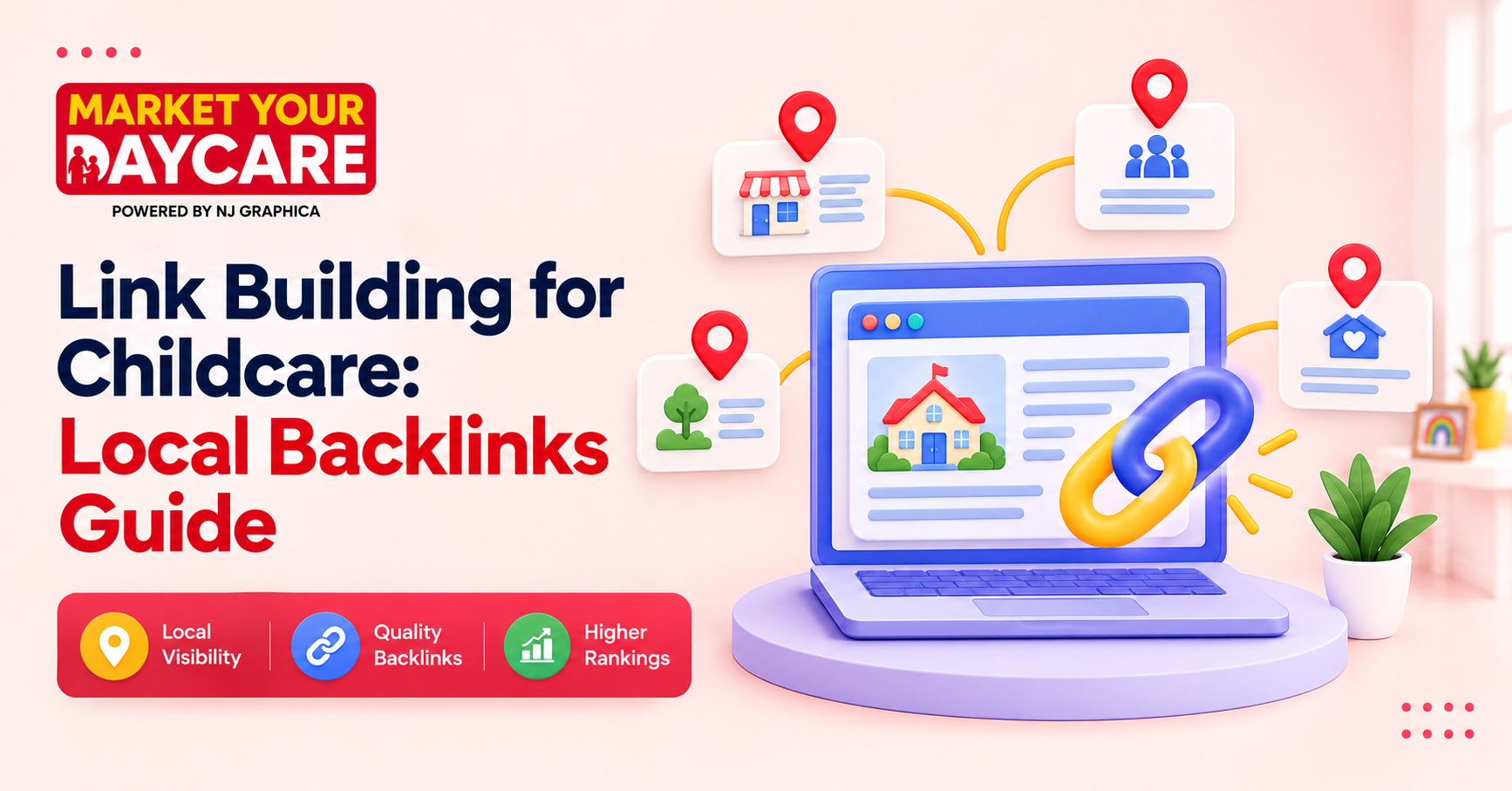
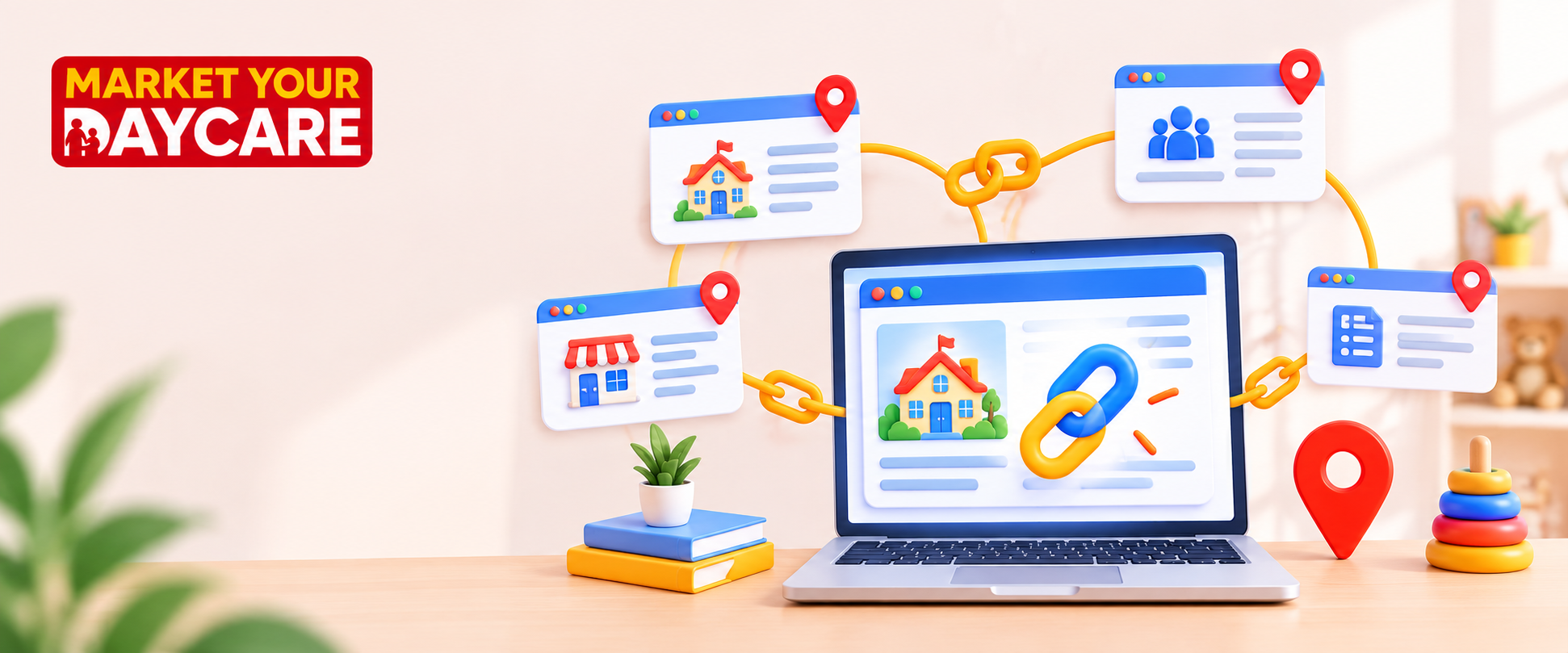
Link building for childcare isn’t about chasing numbers. It’s about earning mentions and links from local organisations that parents already trust: schools, councils, libraries, community groups, and local media. These backlinks signal to Google that your centre is a real, active part of the community, not just another business listing. That local relevance is exactly what good Seo for childcare centre strategies are built on. When you focus on community-based links instead of generic directories, you strengthen your local search presence in a way that actually drives enquiries and tours from nearby families.
Table of Contents
-
What backlinks are and why they matter
-
Why local links beat random ones for daycares
-
Which local organisations to target
-
How to approach them without sounding salesy
-
Simple link-worthy ideas for your centre
-
Tracking your progress without getting lost in data
-
Why Market Your Daycare matters
-
Conclusion
-
FAQ
What backlinks are and why they matter
A backlink is simply a link from another website to yours. Think of it like a digital recommendation. When a reputable site links to you, it’s telling search engines, “This content is worth checking out.”
Google and other search engines use these links as part of their ranking algorithms. Not as the only factor, but as a strong signal of credibility and authority.
For a childcare centre, backlinks help in two main ways:
-
They improve your overall domain authority, which supports your ability to rank for competitive terms.
-
They reinforce your local relevance, especially when the linking site is geographically close or community-focused.
You’re not trying to collect hundreds of links from anywhere. You’re trying to earn a smaller number of meaningful links from places that make sense for your centre.
Why local links beat random ones for daycares
Here’s the key point. A link from a local primary school, council page, or community newsletter is often more valuable for a daycare than a link from a generic directory or an unrelated blog.
Why? Because childcare is inherently local. Parents aren’t searching for “best childcare in Australia.” They’re searching for “childcare in [suburb],” “daycare near [school],” or “preschool close to work.
Google knows this. That’s why local relevance plays a huge role in local pack rankings and suburb-specific searches. A backlink from a trusted local organisation tells Google your centre is part of that community fabric.
Compare that to a link from a random directory with no local connection. It might add a tiny bit of authority, but it doesn’t reinforce your geographic relevance. And for a daycare, geographic relevance is what turns searches into enquiries.
So if you’re choosing where to focus your energy, local organisations are the high-value targets.
Which local organisations to target
You don’t need a massive list. You need a focused one. Here are the types of local organisations that often make sense for childcare centres:
1. Local primary and secondary schools
Many schools have community partner pages, feeder program listings, or event recaps that include links to local early learning centres. If you run transition-to-school programs or host school readiness workshops, that’s a natural angle.
2. Local councils and community centres
Councils often list local services, family support programs, and community initiatives on their websites. If you participate in council-run events, grants, or family programs, you can often earn a mention with a link.
3. Libraries and early literacy programs
Public libraries frequently run storytime sessions, early literacy initiatives, or parent-child reading programs. Partnering with them or hosting joint events can lead to listings on their “community partners” or events pages.
4. Local sports clubs and family events
Youth sports teams, weekend family festivals, and school fundraisers often have sponsor or partner pages. Even a small sponsorship can earn you a link and local visibility.
5. Parenting blogs and local news sites
Local parenting blogs, “Best of [Suburb]” lists, and community news outlets often feature local businesses, especially when there’s a story angle: a new program, a milestone, a community initiative.
6. Business associations and chambers of commerce
Local business directories, chamber of commerce member pages, and industry associations often include backlinks to member websites. These aren’t the most powerful links on their own, but they add up as part of a broader local profile.
7. Family support and health services
Maternal and child health centres, playgroups, speech therapists, and occupational therapists sometimes list local referral partners. If you have professional relationships with these services, there may be opportunities for mutual mentions.
The common thread? All of these are organisations that local families already interact with. That’s what makes the links valuable.
How to approach them without sounding salesy
This is where a lot of centres get stuck. They worry about coming across as pushy or transactional.
The trick is to frame your outreach around mutual value, not just “can I have a link?”
1. Start with relationship, not request
If you’re reaching out to a school, library, or council, start by referencing an existing connection or shared goal.
For example:
“We’ve been running a school readiness program for local families and would love to explore how we might support [school name]’s transition initiatives. Are you open to a quick chat about possible collaboration?”
That opens the door without demanding anything upfront.
2. Offer something useful
People are more likely to link to you if you’re offering value. That could be:
-
A free workshop for parents
-
A joint community event
-
A resource pack for families
-
A guest article for their blog or newsletter
-
Support for a local initiative or fundraiser
When you lead with contribution, the link becomes a natural byproduct, not the main ask.
3. Keep the ask simple
Once there’s interest, you can gently introduce the idea of a mention.
For example:
“If it fits with your site, we’d be grateful for a mention on your community partners or events page so local families can find us easily. Happy to provide a short description and logo if that helps.”
Clear, polite, and low-pressure.
4. Follow up respectfully
If you don’t hear back, one gentle follow-up after a week or two is fine. More than that and you risk becoming noise.
The goal is to be persistent, not pesky.
Simple link-worthy ideas for your centre
You don’t need a massive budget or a PR team. You need a few repeatable ideas that make it easy for local organisations to say yes.
Here are some practical options:
1. Host a free parenting workshop
Topics could include:
-
Supporting early literacy at home
-
Managing big emotions in toddlers
-
Preparing for the transition to school
Invite local families and let partner organisations know they’re welcome to share the event. They’ll often list it on their events or community pages with a link back to you.
2. Run a community drive or fundraiser
Think book drives, toy donations, uniform swaps, or fundraising for a local cause. Promote it in partnership with a school, library, or council. Event pages and recaps often include links to participating organisations.
3. Create a local family resource page
Build a page on your site that lists helpful local resources: parks, libraries, health services, playgroups, family support. Then reach out to those organisations and let them know they’re included. Some will link back as a reciprocal resource.
4. Share local data or insights
If you have non-sensitive insights (e.g., “X% of local families value outdoor play,” or “Top concerns for new parents in [suburb]”), local news sites and parenting blogs may be interested in covering it. That kind of story often includes a link to your centre as the source.
5. Partner on early literacy or school readiness
Offer to co-host storytime at the library, run a “meet the teacher” session with a local primary school, or provide a transition-to-school info night. These programs naturally generate listings, event pages, and recaps with links.
6. Sponsor a local team or event
Even a modest sponsorship of a junior sports team, school fundraiser, or family festival can earn you a spot on their sponsors page. It’s not the most powerful link on its own, but it adds to your local footprint.
The key is consistency. One event won’t transform your SEO. A steady rhythm of community involvement will.
Tracking your progress without getting lost in data
You don’t need a complicated dashboard. You need a simple way to see if your efforts are moving the needle.
Here’s a lightweight approach:
1. Keep a simple spreadsheet
Track:
-
Organisation name
-
Contact person
-
Date of outreach
-
Status (pending, confirmed, live)
-
Link URL (once live)
That’s enough to stay organised without overcomplicating things.
2. Monitor local rankings
Use a basic rank tracker or even manual checks for key terms like:
-
“Childcare in [suburb]”
-
“Daycare near [school]”
-
“Preschool [suburb]”
If your local rankings improve over time alongside new links, that’s a good sign.
3. Watch enquiry sources
Ask new families how they found you. If more mention “Google,” “local council site,” or “school website,” your local link building is likely helping.
4. Check your backlink profile occasionally
Free or low-cost tools can show you new backlinks over time. You’re not chasing a number. You’re confirming that your efforts are resulting in real links from relevant sites.
That’s enough to know if you’re on the right track.
Common mistakes centres make
There are a few traps that keep showing up.
1. Chasing quantity over quality
Submitting to hundreds of low-quality directories won’t move the needle. A handful of strong local links will.
2. Ignoring existing relationships
Many centres already work with schools, libraries, or councils but never think to ask for a mention. Start with who you already know.
3. Making it all about links
If your outreach feels transactional, people will sense it. Focus on genuine collaboration and community value. Links follow naturally.
4. Giving up too soon
Link building is a slow game. You might send ten emails to get two yeses. That’s normal. Consistency matters more than speed.
5. Forgetting to maintain relationships
Once a link is live, don’t disappear. Say thanks. Share their content. Stay on their radar for future collaborations. That’s how you turn one-off links into ongoing partnerships.
Avoiding these mistakes keeps your efforts sustainable and effective.
The link between local links and occupancy
Here’s the bigger picture.
Local backlinks don’t just improve rankings. They improve trust. When a parent sees your centre mentioned on a school page, a council site, or a local news article, it reinforces that you’re a real, trusted part of the community.
That affects decisions. A parent comparing two centres might choose the one that feels more embedded locally, even if the other is slightly cheaper or closer.
And when your local search visibility improves, so does your enquiry rate. More enquiries mean more tours. More tours mean more enrolments. And in a sector where every empty spot costs you, that’s not a small thing.
So yes, this is an SEO tactic. But it’s also an occupancy tactic.
Why clear communication matters
Let’s circle back to the human side.
Link building isn’t just about algorithms. It’s about relationships. When you approach local organisations with respect, clarity, and a genuine desire to contribute, you build goodwill that goes beyond a single link.
That goodwill shows up in other ways too: referrals, joint events, word-of-mouth recommendations. All of which support your broader marketing and enrolment goals.
And when your online presence reflects that community connection, parents feel it. They see a centre that’s not just open for business, but invested in the area.
That’s the kind of trust that fills rooms.
Why Market Your Daycare matters
This is where marketyourdaycare fits in.
Market Your Daycare focuses on helping Australian childcare centres reach 90–100% occupancy through results-driven marketing. Part of that work includes building strong local search presence, including strategic link building.
A specialised agency understands that daycares don’t need generic link schemes. They need community-based links that reinforce local relevance and trust.
That’s where tailored Seo for childcare centre strategies come in. The right provider will:
-
Identify high-value local organisations in your catchment
-
Craft outreach that feels collaborative, not transactional
-
Develop link-worthy initiatives like events, workshops, and resources
-
Track impact on local rankings and enquiries, not just link counts
-
Integrate link building with your broader local SEO and content plan
Working with a team that gets the childcare context means you’re not paying for abstract SEO. You’re paying for a system designed to fill your rooms.
And that’s the difference between looking good on paper and seeing real enrolment growth.
Turning links into local authority
At the end of the day, backlinks are just one piece of the puzzle. But for a daycare, the right kind of links can be disproportionately powerful.
A link from a local school, council, or community group doesn’t just boost your SEO. It tells parents, “This centre is part of our community.” That’s a message that resonates far beyond search rankings.
When you focus on earning those links through genuine contribution, you’re not just building authority. You’re building reputation.
Conclusion
Link building for childcare isn’t about chasing numbers or gaming algorithms. It’s about earning mentions and links from local organisations that parents already trust.
When you focus on community-based backlinks, you strengthen your local search presence in a way that directly supports enquiries and enrolments. And when you work with the right Seo for childcare centre strategies, you can turn those links into a steady pipeline of local visibility and trust.
FAQ
1. What are backlinks and why do they matter for childcare centres?
Backlinks are links from other websites to yours. They act as digital recommendations and help search engines see your site as credible and relevant, which can improve rankings.
2. Why are local backlinks more valuable than generic ones?
Local backlinks from schools, councils, and community groups reinforce your geographic relevance, which is crucial for ranking in local searches that parents actually use.
3. Which local organisations should I target for backlinks?
Target local schools, councils, libraries, sports clubs, parenting blogs, business associations, and family support services that already interact with families in your area.
4. How do I ask for a backlink without sounding pushy?
Focus on offering value first, like workshops, events, or resources, then gently suggest a mention on their community or events page if it fits their site.
5. How can Seo for childcare centre strategies help with link building?
Seo for childcare centre strategies can identify high-value local link opportunities, craft collaborative outreach, and integrate link building with your broader local SEO to drive enquiries and occupancy.