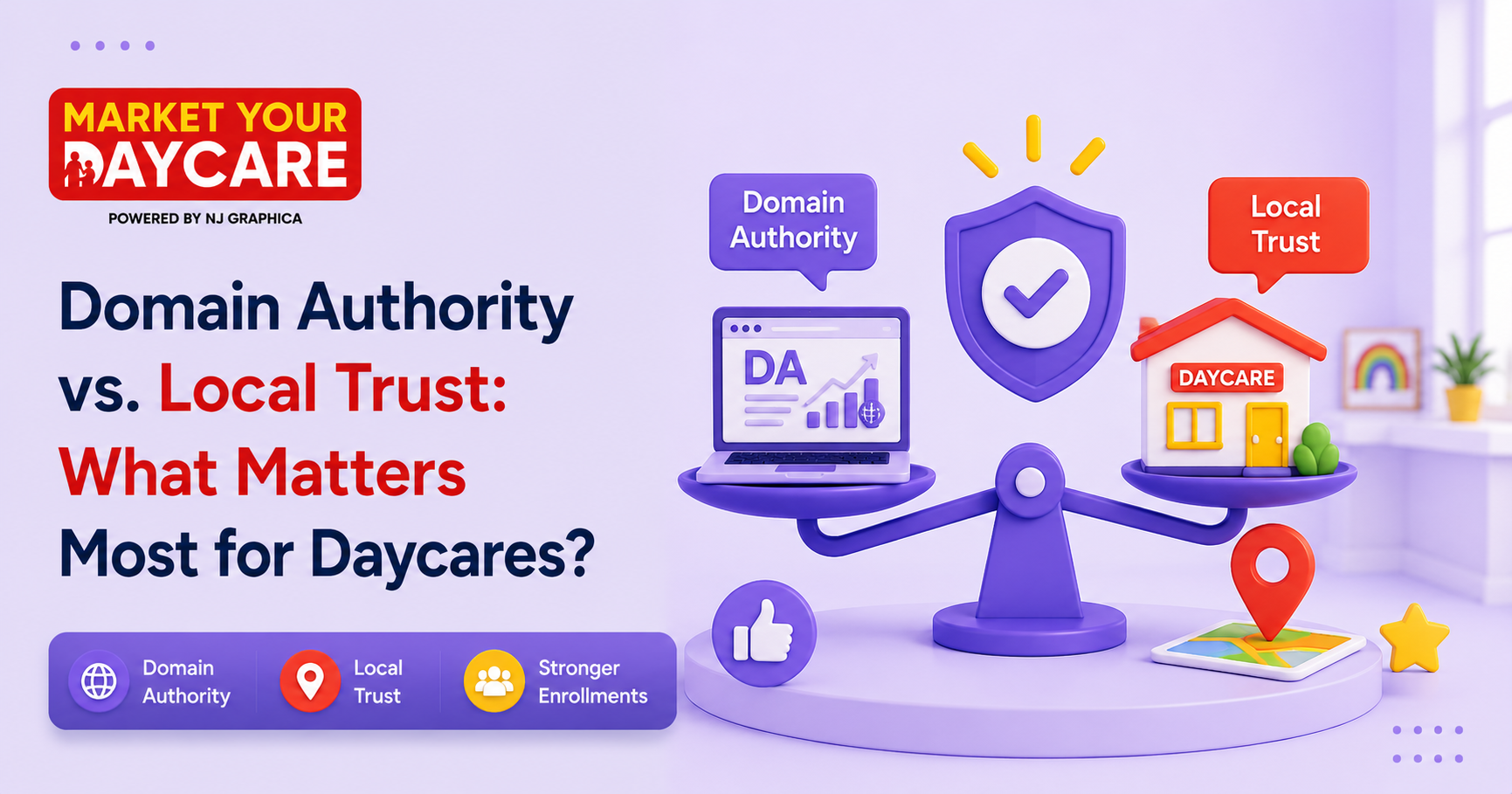
Domain authority is a third-party metric that estimates how “strong” a website looks to search engines based on factors like backlinks and age. Local trust, on the other hand, is about how credible and relevant your centre appears to families in your area through Google Business Profile, reviews, and local signals. For most daycares, local trust has a much bigger impact on enquiries than chasing a high domain authority score. That doesn’t mean your website quality doesn’t matter. It does. But if you’re choosing where to focus first, local signals usually move the needle faster. And when you work with the right childcare SEO services, you can build both in a way that actually fills your rooms.
Table of Contents
-
What domain authority actually is
-
What local trust means for daycares
-
How Google decides what to show parents
-
Why local trust usually wins for childcare
-
When domain authority still matters
-
Building a simple local-first SEO plan
-
Why Market Your Daycare matters
-
Conclusion
-
FAQ
What domain authority actually is
Domain authority (often shortened to DA) is a score created by SEO tool companies, not by Google itself. It’s meant to estimate how likely a website is to rank well in search results based on factors like the number and quality of backlinks, site age, and overall link profile.
Think of it like a credit score for websites. The higher the number, the more “authority” the domain is assumed to have. Big national brands, universities, and long-established sites often have high DA because they’ve accumulated lots of links over time.
But here’s the catch. Google doesn’t use “domain authority” as a direct ranking factor. It’s a proxy metric, useful for comparisons, but not a lever you can pull inside Google’s system.
For a local daycare, your DA might be relatively low compared to big directories or franchise chains. That’s normal. It doesn’t mean you can’t rank. It just means you’re playing a slightly different game.
What local trust means for daycares
Local trust is less about a single number and more about a cluster of signals that tell Google, “This business is real, relevant, and trusted by people nearby.”
For a childcare centre, that includes things like:
-
A complete, active Google Business Profile (GBP)
-
Consistent name, address, and phone details across the web
-
Genuine parent reviews, especially recent ones
-
Local citations in directories and community sites
-
Suburb-specific pages and content on your website
-
Clear information about programs, fees, and enrolment
These signals help you show up in the local pack (the map results) and in “near me” searches.
Parents aren’t searching for “best childcare in Australia.” They’re searching for “childcare in [suburb],” “daycare near [landmark],” or “preschool close to work.” That’s a local intent query. And Google treats it differently from a broad, national search.
Local trust is about being the obvious choice in that specific area.
How Google decides what to show parents
When a parent types in a local childcare search, Google runs a mini-auction of relevance, not just authority.
Key factors in local rankings include:
-
Proximity to the searcher
-
Completeness and activity on your Google Business Profile
-
Review volume, recency, and sentiment
-
Relevance of your website content to the search
-
Consistency of your business details across the web
-
Local backlinks and mentions
Domain authority plays a role, but it’s a smaller one in local pack rankings. A 2025 study cited by SEO analysts found domain power accounted for around 5.9% of local pack ranking factors, while proximity, reviews, and GBP completeness carried significantly more weight.
In plain English: a centre with a modest website but strong local signals can outrank a centre with a higher DA but weak local presence.
That’s good news for independent daycares. You don’t need to beat national directories on authority. You need to beat your local competitors on trust.
Why local trust usually wins for childcare
Childcare is hyper-local. Most families aren’t willing to drive more than 15–20 minutes, especially for long-term care. That means your real competition isn’t every centre in the country. It’s the handful within a few kilometres.
In that context, local trust matters more because:
1. Parents care about what’s nearby
A high-authority national directory might rank for broad terms, but parents quickly filter by location. Your goal is to win in your suburb, not on a national leaderboard.
2. Reviews drive decisions
Parents read reviews like they’re references. A centre with 40 recent 5-star reviews will often beat a centre with a fancier website but only a handful of old reviews.
3. Google Business Profile is your front door
For many parents, your GBP is the first thing they see. Photos, hours, services, and reviews show up before they even click through to your site. If that profile is weak, your DA doesn’t matter much.
4. Local relevance beats generic authority
Google wants to show results that match the searcher’s intent. A page about “toddler program in [suburb]” is more relevant to a local parent than a generic homepage with high authority but no local detail.
5. Independent centres can compete
National chains and aggregators often dominate broad terms like “daycare” or “childcare.” But independent operators consistently break through on geo-modified and service-specific queries where local relevance matters more than domain authority.
So if you’re weighing where to invest your time and budget, local trust is usually the higher-return starting point.
When domain authority still matters
None of this means domain authority is useless. It’s just not the main event for most daycares.
DA becomes more relevant when:
-
You’re competing in a dense, highly competitive metro area with many well-optimised centres
-
You want to rank for broader, non-local terms (e.g., “early learning resources Australia”)
-
You’re planning long-term content strategies that rely on organic search beyond local queries
-
Your local competitors all have strong GBP and reviews, so you need extra edge
In those scenarios, improving your site’s overall authority can help. That might include:
-
Earning backlinks from local schools, community groups, or news sites
-
Publishing high-quality, parent-focused content that attracts links
-
Ensuring your site is technically sound and fast
-
Building suburb and program pages that earn organic traction over time
But even then, you’re not chasing a DA number for its own sake. You’re building a stronger, more credible site that supports your local goals.
Think of domain authority as a supporting actor, not the lead.
Building a simple local-first SEO plan
You don’t need a 50-point checklist. You need a clear, repeatable plan that focuses on what moves the needle for a daycare.
Here’s a straightforward framework:
1. Optimise your Google Business Profile
This is your single highest-impact move.
Make sure you:
-
Claim and verify your profile
-
Fill in every field: address, phone, hours, services, description
-
Upload high-quality photos of your spaces, educators, and activities
-
Choose accurate categories (e.g., “Child care agency,” “Preschool”)
-
Post updates regularly: openings, events, holiday programs
-
Respond to all reviews, positive and negative
This is the foundation of your local trust.
2. Get your NAP consistent
NAP stands for name, address, phone. It needs to be consistent across:
-
Your website
-
Your Google Business Profile
-
Local directories (TrueLocal, Yellow Pages, HotFrog, etc.)
-
Community and parent-focused listings
Inconsistencies confuse Google and erode trust.
3. Build suburb and program pages
Create dedicated pages for:
-
Each suburb you serve
-
Each age group or program (nursery, toddlers, kinder, etc.)
-
Key parent questions (fees, CCS, transition to school, etc.)
These pages help you rank for specific local queries and show parents you understand their context.
4. Generate genuine parent reviews
Set up a simple, ethical system for asking satisfied families to leave Google reviews. Tie requests to positive moments: successful transitions, compliments, milestones.
Respond to every review. That shows you’re engaged and care about feedback.
5. Fix your website basics
You don’t need a perfect site. You need a functional one.
Ensure:
-
Mobile-friendly design
-
Fast loading speed
-
Clear calls to action (“Book a tour,” “Enquire now”)
-
Simple navigation for parents
-
Basic on-page SEO (titles, headings, meta descriptions with suburb and program keywords)
This supports your local efforts and improves conversion once parents click through.
6. Track what matters
Don’t get lost in vanity metrics. Focus on:
-
Number of enquiries from Google
-
Tour bookings
-
Phone calls and map direction requests
-
Review growth and rating
-
Rankings for key local terms
That’s how you know your efforts are actually filling places.
Common mistakes centres make
There are a few traps that keep popping up.
1. Obsessing over domain authority
Spending months trying to boost DA while your Google Business Profile is half-empty is like polishing the bonnet of a car with no engine.
2. Ignoring reviews
Some centres don’t ask for reviews at all. Others only ask when they need a quick boost. Both approaches weaken local trust over time.
3. Generic website content
Homepages that say “Welcome to our centre” with no suburb, program detail, or parent-focused information miss a big opportunity.
4. Inconsistent business details
Different phone numbers or addresses across directories confuse Google and parents. It’s an easy fix that many centres overlook.
5. Treating SEO as a one-off project
SEO isn’t something you do once. It’s ongoing. Profiles need updates. Reviews need responses. Content needs refreshing.
Avoiding these mistakes keeps your efforts focused and effective.
The link between local trust and occupancy
Here’s the bigger picture.
Local trust doesn’t just improve rankings. It improves conversion. A parent who sees a strong Google profile with recent reviews, clear photos, and detailed information is more likely to:
-
Click through to your website
-
Call or enquire
-
Book a tour
-
Enrol
That directly affects your occupancy. And in a sector where every empty spot costs you, that’s not a small thing.
Domain authority might help you rank for some broader terms over time. But local trust is what turns nearby searches into enrolled families right now.
Why clear communication matters
Let’s circle back to the human side.
SEO isn’t just about algorithms. It’s about how parents perceive your centre online. Your Google profile and website are often the first interaction a family has with you.
If they look incomplete, outdated, or generic, parents start to wonder. If they look thoughtful, current, and parent-focused, trust builds faster.
That’s why local trust is so powerful. It aligns your online presence with what parents actually care about: proximity, quality, communication, and reassurance.
And when your digital footprint matches the quality of your care, enquiries follow.
Why Market Your Daycare matters
This is where marketyourdaycare fits in.
Market Your Daycare focuses on helping Australian childcare centres reach 90–100% occupancy through results-driven marketing. Part of that work includes building strong local search presence, not just chasing abstract authority metrics.
A specialised agency understands that daycares don’t need to compete with national directories on domain authority. They need to dominate their local area on trust signals that parents actually use.
That’s where tailored childcare SEO services come in. The right provider will:
-
Prioritise Google Business Profile optimisation
-
Build suburb and program pages that match parent searches
-
Set up ethical review generation systems
-
Ensure NAP consistency across directories
-
Track enquiries and tour bookings, not just rankings
Working with a team that gets the childcare context means you’re not paying for generic SEO. You’re paying for a system designed to fill your rooms.
And that’s the difference between looking good on paper and seeing real enrolment growth.
Turning visibility into enrolments
At the end of the day, SEO isn’t about scores. It’s about families finding you, trusting you, and choosing you.
Domain authority has its place in a long-term strategy. But for most daycares, local trust is the lever that moves occupancy faster.
When you focus on what matters to parents in your area, your online presence stops being a nice-to-have and starts being a steady enrolment channel.
Conclusion
Domain authority vs. local trust isn’t really a fair fight for daycares. Local trust wins because childcare is inherently local, and parents make decisions based on nearby options, reviews, and clear, relevant information.
That doesn’t mean you ignore your website quality. It means you prioritise the signals that drive local enquiries first. And when you work with the right childcare SEO services, you can build a local-first strategy that consistently turns searches into tours and tours into enrolments.
FAQ
1. What is domain authority?
Domain authority is a third-party metric that estimates how “strong” a website looks to search engines based on factors like backlinks and site age. It’s not a direct Google ranking factor.tryplayground+1
2. What is local trust in SEO?
Local trust refers to signals like Google Business Profile completeness, reviews, local citations, and suburb-specific content that show Google your business is credible and relevant in a specific area.local-seo+1
3. Which matters more for daycares: domain authority or local trust?
For most daycares, local trust matters more because parents search locally and Google weights proximity, reviews, and GBP signals more heavily than domain authority in local rankings.dapa-checker+1
4. Can a centre with low domain authority still rank well?
Yes. Independent centres often outrank higher-authority sites on local and geo-modified queries by focusing on Google Business Profile, reviews, and relevant local content.enrollandco+1
5. How can childcare SEO services help?
Childcare SEO services can prioritise local trust signals, optimise your Google Business Profile, build suburb and program pages, generate reviews, and track enquiries to help you fill vacancies more effectively.