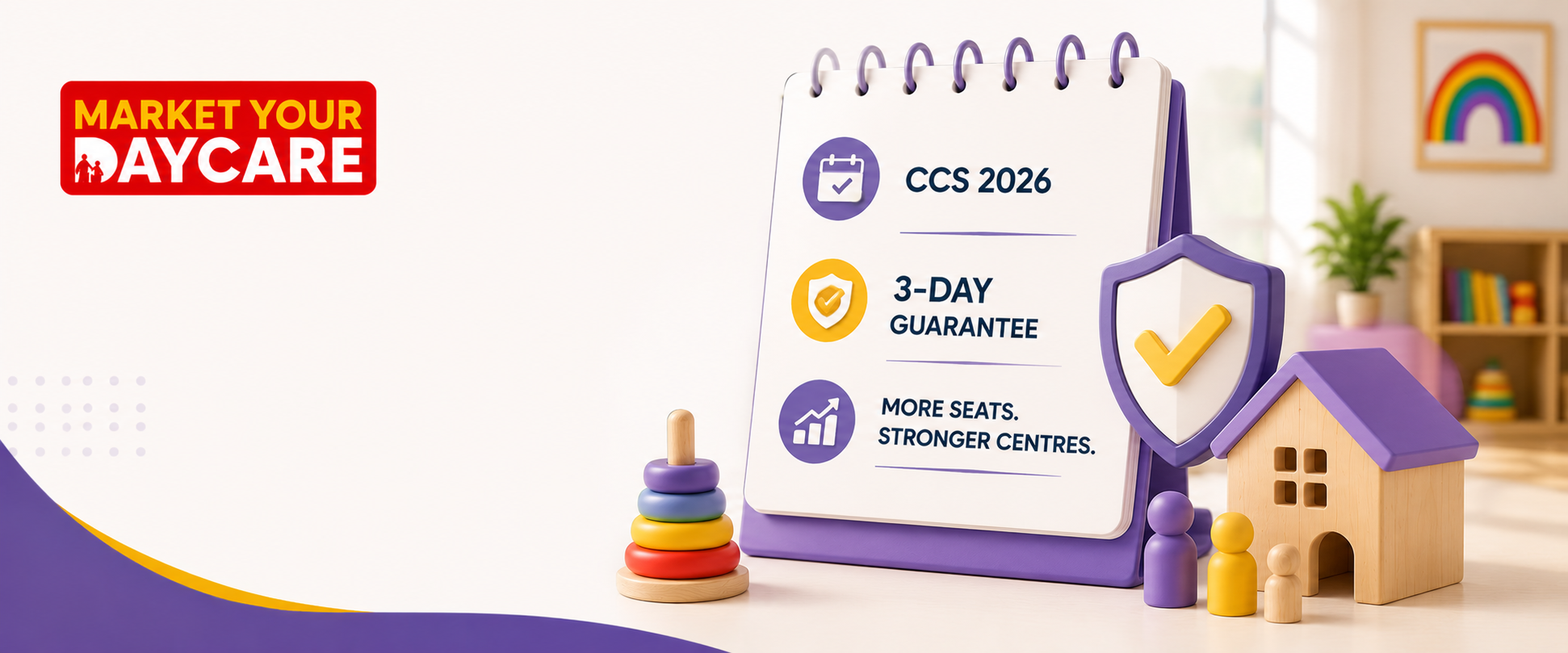
Australia's childcare landscape shifted quietly in 2026 — and most centre directors I've spoken to are still catching up. The updated Child Care Subsidy rules, especially the 3-day activity guarantee, changed the way families search for care and how fast they commit. If your enrolment system hasn't kept pace, you're probably losing families to competitors. As a specialized child care marketing agency, we have seen that centres adapting their digital strategy to these changes are filling their spots instantly, while those relying on old methods are being left behind.
This isn't about scare tactics. It's just what's actually happening. Families now have more confidence about what they'll pay, and they're acting on it faster. That's good news if your centre responds quickly. It's a slow leak if you don't.
Table of Contents
-
What Actually Changed with CCS in 2026
-
What the 3-Day Activity Guarantee Means for Your Centre
-
Why Families Are Moving Faster
-
The Occupancy Gap Most Directors Don't Talk About
-
How to Fix Your Pipeline Before the Next Enquiry Comes In
-
How a Childcare Marketing Agency Makes This Easier
-
Why Market Your Daycare
-
Conclusion
-
FAQs
1. What Actually Changed with CCS in 2026
Here's the short version: the government firmed up the activity test and made the 3-day minimum guarantee a clearer floor for eligible families.
Before the update, families who met the activity test at low hours still felt uncertain about how many subsidised days they'd actually get. That uncertainty made them delay. They'd enquire, tour, and then sit on the decision for two or three weeks trying to sort out their CCS entitlements before committing to anything.
The 2026 changes fixed that. If a family meets the activity test at any level — even part-time work or study — they're generally entitled to at least three days a week of subsidised care. That clarity removed a lot of the "we need to figure out what we can afford first" hesitation.
Which sounds great. And it is. But it also means families who used to delay are now moving faster. They know their baseline entitlement earlier. So the window between "we're interested" and "we've decided on another centre" has gotten shorter.
2. What the 3-Day Activity Guarantee Means for Your Centre
Think about the families who enquired at your centre in the last six months and didn't enrol. If you called them now and asked why they went elsewhere, most of them probably wouldn't say the other centre was better. They'd say something like "we just found a place first" or "they got back to us straight away."
That's not a marketing problem. That's a response speed problem.
The 3-day guarantee took away the CCS calculation delay that used to give centres a bit of extra time. Families used to need a week or so to get their subsidy estimates sorted. Now they're ready to commit within 48 to 72 hours of first contact — if the centre makes it easy for them.
If your team's first call back happens 24 hours after the enquiry lands, you're handing a lot of those families to whoever called first. It's not complicated to fix. It's just uncomfortable to look at honestly.
3. Why Families Are Moving Faster
There's another side to this. Families aren't just moving faster because the subsidy situation is clearer. They're also moving faster because competition for spots in a lot of suburbs has picked up.
When families know they qualify for 3 subsidised days and they're confident about their entitlement, they also get anxious about missing out — especially for infant care, where capacity is already tight. That anxiety makes them act.
So you've got a double effect. Families are more financially confident and more worried about losing a spot. Both things push them toward making a decision fast.
Your centre either catches that moment or it doesn't.
4. The Occupancy Gap Most Directors Don't Talk About
I've sat through enough centre reviews to notice that most occupancy conversations focus on the number itself — 70%, 78%, 82%. What doesn't get talked about nearly enough is where the gap is actually coming from.
The most common finding: the leads are already there. Enquiries are happening. Families are finding the centre, visiting the website, sometimes even doing a tour. And then disappearing.
Not because the centre was a bad fit. Not because the fees were too high. Because the follow-up was slow, the CCS conversation happened at the end of the tour instead of the start, and nobody sent anything after the family walked out.
That's the real occupancy gap. It's not a visibility problem for most centres sitting at 70 to 80 percent. It's a pipeline problem. Effective child care marketing isn't just about getting more eyeballs on your centre — it's about fixing what happens after a family finds you. And the 2026 CCS changes have made that gap more expensive to ignore, because families are now committing to another centre in days, not weeks.
5. How to Fix Your Pipeline Before the Next Enquiry Comes In
You don't need a full overhaul to start seeing results. There are three things worth looking at first.
Put CCS clarity at the start of the tour, not the end.
Most centres hand out a CCS information sheet as an afterthought after the tour's done. That's backwards. If a family leaves without knowing what they'll actually pay out of pocket, they go home to google it. While they're doing that, another centre calls them.
Put a simple worked example in front of families at the start. Use realistic income figures for your suburb, show them the calculation, give them a number. It removes the financial uncertainty before the tour even begins — and makes everything after that about fit, not cost.
Call within two hours.
There's a lot of data on this and it all points the same direction. Centres that call a new enquiry within two hours convert 40 to 50 percent of those leads to tour bookings. Centres that wait until the next day see 18 to 25 percent.
On 30 monthly enquiries, that difference works out to somewhere between six and thirteen tour bookings. At a 55 percent tour-to-enrolment rate, that's three or four enrolments every month — from the same leads, just faster follow-up.
Send something after the tour.
Not an automated thank-you. An actual message from a real person: "Hi [name], great meeting you and [child's name] today — is there anything stopping you from reserving their spot?" Most families are just waiting for someone to ask. The centres that do this convert at measurably higher rates without spending a dollar more on marketing.
6. How a Childcare Marketing Agency Makes This Easier
Here's the honest version of this: a good childcare marketing agency doesn't just run ads. The ads part is relatively straightforward. What takes time — and what most directors don't have — is the system behind the ads.
The landing page that converts at 14 percent instead of two. The five-touch follow-up sequence that works a lead from Day 0 to Day 14. The pre-tour confirmation that drops no-show rates from over 30 percent to under 10. Building all of that alongside running a centre takes months.
A childcare marketing agency that's done it before can deploy it in weeks.
The other thing a specialist brings is sector knowledge. The way a CCS conversation works in a childcare tour is specific. The effect of ACECQA ratings on Google Maps rankings matters. The way parents in competitive suburbs search and compare is different from other service industries. A generalist doesn't know any of that, and honestly doesn't need to — they're not in childcare every day.
Working with a childcare marketing agency that understands the full pipeline changes occupancy at the rate directors are actually looking for. Not impressions and reach — enrolments.
7. Why Market Your Daycare
Market Your Daycare works exclusively with Australian childcare centres. That's not accidental. The enrolment system for a childcare centre is specific enough that a generalist approach rarely moves the needle in any meaningful way.
The framework we use is called the No Empty Seat Method. It's a six-stage system covering local visibility, paid traffic, lead capture, follow-up speed, tour conversion, and weekly KPI tracking. Every engagement starts with the Childcare Occupancy Scorecard — a free 3-minute diagnostic that shows which of those six stages is producing the biggest revenue leak at your specific centre.
The results from centres we've worked with: a 60-place Sydney centre recovering $25,718 in monthly revenue in 45 days without increasing ad spend. A centre that went from 72 percent occupancy to 100 percent in six months. Waitlists forming in age groups that couldn't fill six months earlier.
We don't take every centre that applies. Before any engagement starts, we check whether 95 percent occupancy is genuinely achievable for your suburb and age group mix. If we don't think it is, we'll say so on the first call.
As a dedicated childcare marketing agency that reports on enrolments — not reach, not impressions, not follower counts — the starting point for every centre is the same: find out where the pipeline is leaking. The Scorecard does that in three minutes, for free.
Conclusion
The 2026 CCS changes and the 3-day activity guarantee have made one thing clear: families are deciding faster than they used to. That's great for centres set up to respond quickly. It's a problem for centres that still treat a new enquiry as something to get to later.
For most centres sitting at 70 to 80 percent occupancy, the fix isn't more advertising. It's a faster first call, a CCS conversation early in the tour, and a post-tour message that actually asks for the booking. Those three things move occupancy without changing the ad budget at all.
If you want to see the full picture of where your specific centre is leaking, the Childcare Occupancy Scorecard is the fastest way to find it. Twelve questions, three minutes, personalised result. No sales call required to see what comes back.
FAQs
Q1. What exactly is the 3-day activity guarantee under the 2026 CCS changes?
Under the updated Child Care Subsidy rules, families who meet the activity test at any level are now entitled to a minimum of three subsidised days per week. This replaced the more complicated tiered system that made it genuinely hard for lower-activity families to predict their entitlement upfront. The practical effect: more families know their baseline subsidy before they start looking at centres, which means they're committing to decisions faster.
Q2. How does the CCS change affect my centre's tour conversion rate?
It mostly removes one of the main stall points in a family's decision. Previously, families would tour a centre and delay committing while they sorted out subsidy estimates. Now they have more clarity earlier. That means the gap between "we're interested" and "we've signed with someone else" has gotten shorter. Centres that put CCS information early in the tour and follow up the same day tend to see noticeably better conversion rates.
Q3. My occupancy has been stuck around 70 to 75 percent for months. Is that a marketing problem?
Probably not — at least not in the way most people mean. For most centres in that range, the enquiries are already coming in. What's usually broken is what happens after the enquiry lands: slow first-call response, no follow-up sequence, no pre-tour confirmation, no closing message after the tour. Those are pipeline problems, not awareness problems. Adding more ad spend to a leaking pipeline mostly just means more leads going cold faster.
Q4. Should I change anything on my website because of the CCS updates?
One quick win: add a worked CCS example to your fees page. Use realistic income figures for your area and show families what they'd actually pay per day after subsidy. It takes about 30 minutes to write and it removes one of the most common reasons families delay enquiring. If you're working with a childcare marketing agency, this is usually one of the first content updates they'll suggest.
Q5. How do I know if Market Your Daycare is a good fit for my centre?
The Childcare Occupancy Scorecard is the starting point. Twelve questions, three minutes, and you get a personalised breakdown of which pipeline stage is producing the biggest gap at your centre. If a strategy session makes sense after that, we'll pull your suburb's live Google Search demand data and show you exactly where your enquiries are going — no obligation to go further than that.